
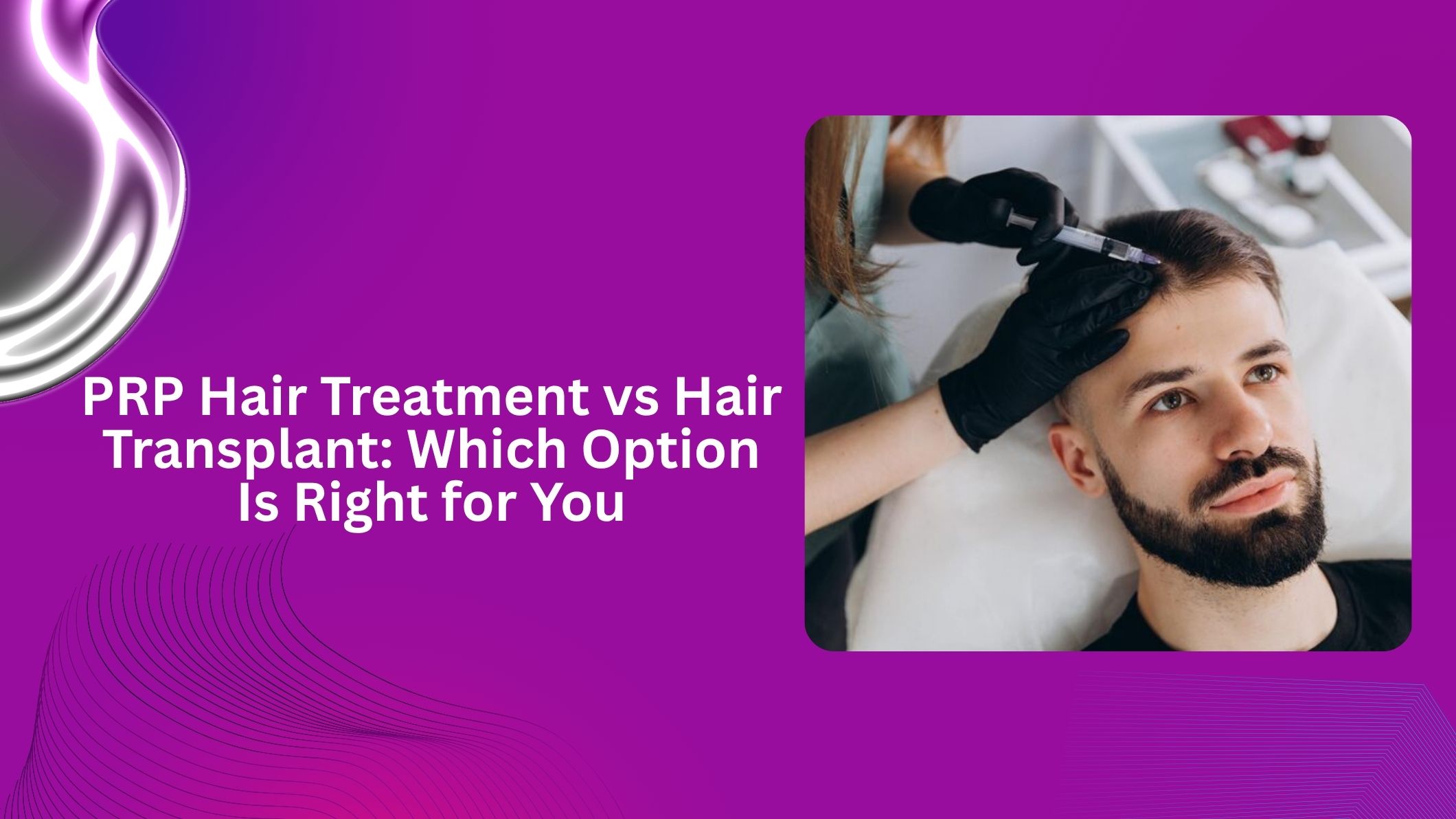
PRP Hair Treatment vs Hair Transplant: Which Option Is Right for You
Hair loss can affect both appearance and confidence, and choosing the right treatment can sometimes feel confusing. Two commonly discussed options for hair restoration are Platelet-Rich Plasma (PRP) therapy and hair transplantation. Although both aim to improve hair growth and appearance, they work in very different ways and are suitable for different situations.
PRP hair treatment is a non-surgical procedure that uses a concentrated portion of the patient’s own blood. After processing, the platelet-rich component is injected into the scalp with the goal of supporting hair follicles and encouraging healthier growth. Hair transplantation, on the other hand, is a surgical procedure in which hair follicles are taken from a donor area and placed into areas affected by hair loss.
The right option depends on factors such as the cause and pattern of hair loss, available donor hair, age, overall health, expectations, and whether the hair follicles are still active.
Understanding PRP Hair Treatment and Hair Transplantation
PRP therapy is generally considered when a person has thinning hair or early-to-moderate hair loss and wants a minimally invasive treatment option. Because the procedure uses the patient’s own blood components, there is no need to transplant hair from one part of the scalp to another.
During PRP treatment, a small blood sample is collected and processed to concentrate the platelets. The prepared plasma is then carefully injected into selected areas of the scalp. The treatment is typically performed as an outpatient procedure, and there is usually little interruption to daily activities.
PRP does not create new hair follicles in areas where follicles are permanently absent. Instead, it may help support existing follicles and improve the appearance of thinning hair in appropriate candidates. Results can vary, and multiple sessions may be recommended depending on the individual’s condition.
Hair transplantation is different because it physically moves hair follicles from a donor area, commonly the back or sides of the scalp, to areas where greater density is desired. Techniques such as Follicular Unit Extraction (FUE) are commonly used to harvest individual follicles before implantation.
A transplant can provide a more significant and long-lasting change when there is sufficient healthy donor hair. However, it is a surgical procedure and requires careful evaluation, planning, recovery, and realistic expectations.
Which Hair Restoration Option May Be Right for You
The choice between PRP and hair transplantation should not be based simply on which treatment sounds more advanced. The pattern and stage of hair loss are important factors.
PRP may be more appropriate for individuals experiencing hair thinning where viable follicles are still present. It can also be considered as part of a broader hair-care strategy under professional guidance. People who want a non-surgical option with minimal downtime may also prefer PRP when they are suitable candidates.
A hair transplant may be considered when there are areas of significant or permanent hair loss and sufficient donor follicles are available. Since transplanted follicles are moved from one area to another, the procedure can restore hair in areas where natural growth has been substantially reduced.
In some cases, PRP and hair transplantation may be used together. PRP may be recommended around a transplant procedure or as part of ongoing hair-management care, depending on professional assessment. Combining treatments should always be based on individual requirements rather than assuming that more treatment will automatically produce better results.
Before choosing either option, it is important to identify the underlying cause of hair loss. Hair loss can be associated with genetics, hormonal changes, nutritional issues, stress, medical conditions, medications, or other factors. Treating the underlying cause may be an important part of achieving sustainable results.
A qualified hair-restoration professional can assess the scalp, hair density, donor area, pattern of hair loss, and individual goals before recommending a treatment plan. Patients should also discuss expected results, possible side effects, recovery requirements, and the number of sessions that may be needed.
Ultimately, PRP and hair transplantation serve different purposes. PRP focuses on supporting existing hair follicles, while transplantation moves follicles to areas affected by hair loss. The best choice depends on the individual’s condition and restoration goals rather than a one-size-fits-all solution.
Carvers provides the best treatment plans regarding PRP hair treatment and hair transplantation, offering personalized professional guidance to help individuals choose suitable hair-restoration options according to their specific needs and goals.